6 Reasons Why Seniors Should Make More of Social Media

Connections to Care Mobile Hero
Home / News & Events / Newsletter

6 Reasons Why Seniors Should Make More of Social Media

Sep 27, 2017

You know the names: Facebook, Twitter, Instagram, YouTube. They’re seemingly everywhere and used by seemingly everyone.

In fact, according to the Pew Research Center, social media is becoming increasingly important for seniors. From 2013-2015, social media use by Americans 65 and older increased from 27% to 34%.

Younger senior citizens were more likely to use social media, with a Pew research study finding that 45% of those under 75 do so, versus 20% of those 75 and older.
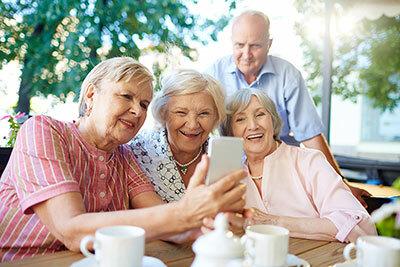
Elderly looking at their phone screen


Pew added social networking use is common among seniors with some college experience and an annual household income of at least $50,000.
Studies also that show social media has become helpful in reducing isolation, loneliness, and other depressive symptoms.

Still, many seniors don’t use social media. And that’s unfortunate. Because social media offers many advantages.

Following are 6 reasons why you should make more of social media.

1. Get connected
Social media gives you the opportunity to reconnect with old friends and make new ones. It’s a simple, entertaining way to learn about what your friends and family are doing—and let them know what you are doing. Sharing experiences is a great way to cement bonds with family and friends.

2. Be entertained
Where else can you see a cat playing the piano, a man juggling a running chainsaw, and a concert pianist playing Bach—all for free? On your phone, on your computer, on your tablet. That’s entertainment!

3. Stay informed
Social media provides a powerful source of news and information. With a simple click, you can learn the latest in politics or the history of China—and so much more. Twitter is great for finding specific news sections you want to follow. Social media helps you get in the know.

4. Have your say
Everybody has an opinion. Social media provides a way to make your voice heard and engage in discussions with people who may (or may not) agree with you. Of course, the first rule in social media: be polite!

5. Check out deals
Social media often runs ads targeted to your particular likes. It also frequently offers special deals to encourage you to purchase.

6. Watch for classes and events
Are there any interesting classes or events being held nearby that might interest you? Social media will tell you where they are and when to go!

If you aren’t using social media, look into it. We think you’ll find it fun and informative.

Sign up for the Los Angeles Jewish Health newsletter, Connections.

Recent Articles

Feb 12

3rd Annual LAJH Classic & Exotic Car Show

Read More
Feb 11

Major Changes in the Tax Law This Year: What It Means for You, Your Taxes, and Your Legacy

Read More
Feb 4

Los Angeles Jewish Health Pays Tribute to Martin Luther King, Jr. and Reflects on His Powerful Legacy

A shared focus on the pursuit of justice made the late Dr. Martin Luther King, Jr. and his contemporaries in the American Jewish community natural allies. This past January, Los Angeles Jewish Health honored their historic collaboration with a special Martin Luther King, Jr. Day event that brought together a diverse audience to celebrate Dr. King and help carry his legacy forward.Overseen by Rabbi Karen Bender, LAJH’s chief mission officer, the gathering featured timeless music blending Jewish songs and themes with gospel sounds rooted in the African American tradition. The program was led by Hazan Mike Stein, who served as cantor of Temple Aliyah—now HaMakom—in West Hills for more than two decades and included contributions from Cantor Jenni Asher, HaMakom’s current cantor; Broadway actress Deborah Sharpe-Taylor; singer Fumani Thomas-Schwartz; pianist David Cohen; and numerous others.“Our goal was to present a fusion of music and ideas about the melding of the two cultures, Jewish and African American,” Stein says. “We sang a song I wrote with Deborah called ‘Shalom, Shalom’; ‘Wade in the Water,’ a traditional African American spiritual that was combined with ‘Mi Chamocha’; ‘We Shall Overcome’; and ‘When the Rain Comes Down,’ which speaks to the universal struggles we all go through, no matter our faith or background. Rabbi Bender also offered a beautiful d’var Torah.”The group performs music which blends songs and themes with gospel sounds rooted in the African American tradition. Rabbi Bender’s words of wisdom helped ground the emotionally uplifting musical tribute, emphasizing how the values of Dr. King align completely with Jewish values.“Our resident community at LAJH intuits the profundity of a message that relates to the principles of justice, equality, and loving-kindness,” she said.A highlight of the event was Sharpe-Taylor’s performance as Harriet Tubman. She offered a first-person portrayal of the iconoclastic activist and brought to life her role in the Underground Railroad.“The residents loved Deborah’s reenactment. She tried to embody Harriet, talking about her life, missing her husband, and bringing people to freedom,” Asher says. “When she was finished, Rabbi Bender got up and said, ‘I almost feel as if I met Harriet Tubman today!’”During the program, Asher, the first Black female cantor to be ordained in the United States, offered insights into her own experience as a Jew of color.“It’s amazing to be visible: I have people come up to me all the time to say they’ve never seen a Black or even a female cantor,” she says. “But Jews and Judaism have moved so far in terms of diversity, and I think it’s impactful for seniors to witness this evolution for themselves. The residents of Los Angeles Jewish Health were so warm and happy to see me, which was wonderful.”Also on hand for the event were William “Mickey” Stevenson and his wife, Michelle. Mickey, a legendary producer at Motown Records and one of the principal architects of the “Motown Sound,” talked about the outstanding partnership at the label between Black artists and its executives, some of whom were Jewish.Cantor Stein says the program was particularly resonant for many of the LAJH residents in the audience.“A lot of the seniors remember the ‘60s and were politically active, some of them playing important roles in advancing civil rights in their local communities,” he says. “In fact, my wife, Kelley, an LAJH resident, was actually at the “I Have a Dream” speech march! When Rabbi Bender talked about how Black and Jewish people are connected by traditions that encompass both being slaves and being free, you could see people nodding along. It’s a powerful link that gives us all common ground to stand up for what’s right.”Cantor Jenni Asher Deborah Sharpe-Taylor as Harriet TubmanWilliam “Mickey” Stevenson 
Read More