Seminars Inform And Stimulate


Seminars Inform And Stimulate
There’s a new activity being offered to seniors living in residential care (RCFE) at the Jewish Home’s Eisenberg Village (EV) Campus. Now, in addition to painting, drama, choir, bingo, and a wide variety of discussion groups and other activities, a monthly educational seminar is available. The seminars focus on topics that are important to seniors. “Our goal is to provide an opportunity for our residents to learn from staff they are familiar with as well as speakers from the community,” said RCFE administrator Ashley Teal. “With their input, we created a list of meaningful topics, such as medication protocol, fraud prevention and reducing the risk of falls.” To date, the seminars have been well received, with attendees asking questions and sharing experiences.
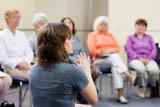
The topic for the most recent seminar was reducing the risk of falls. Everyone knows a fall is something that can happen to anybody at any time: we trip over a loose rug; we fall out of bed; sometimes we stand up too quickly, get dizzy and fall. But do you know the underlying reasons? Presented by EV’s director of rehabilitation, Deborah Crea, MS, PT, the seminar focused on three main causes of falls: balance, posture, and walking speed.
“Our ability to balance is based on three sensory systems: vision, vestibular, or inner ear anatomy, and somatosensory, which is the ability to orient yourself using your joints, muscles, and senses,” explained Deborah. The systems can be affected by many things, including aging, a history of falls, medications, gait, neurological status, use of assistive devices, foot function, cardiovascular status, a fear of falling, vision, incontinence, joint function and pain.
“For posture, the ideal is simple: head up, shoulders back, abdominals tight, and glutes tucked in,” Deborah said. If you’ve ever tried to walk while balancing a book on your head, you get the idea! This struck home with some of the residents, as they talked about the posture challenges presented by using a walker and the importance of having the device at the correct height.
Last, but certainly not least, is walking speed. This is currently a hot topic in the field of physical therapy. “We are now looking at walking speed as a reflection of various underlying physiological processes,” Deborah continued. “Knowing how much time it takes for someone to walk ten feet can help us predict falls.” Walking speed tells the therapist where someone is in their overall conditioning, cardiovascular health, and ability to participate in activities. For someone being discharged from a hospital, it assists in the determination of appropriate level of care, such as assisted living or skilled nursing.
After a fall, physical therapy is needed to help regain or improve overall physical status and reduce the risk of future falls. Balance can be improved by exercises, such as standing with your eyes closed, walking on uneven surfaces, standing on foam, and developing ankle/hip/stepping strategies. Other balance exercises include T’ai chi, yoga, and general strengthening exercises. Specialized testing can determine or rule out vestibular issues.
After physical therapy, the goal is to maintain that newly gained physical status, and hopefully continue to build upon it. “At the EV rehab center, our goal is for physical therapy clients to complete their prescribed therapy and then incorporate exercise into their lifestyle,” said Deborah.
As you can see, the seminars are comprehensive and meant to enhance the knowledge someone may already have about a particular subject. “We hope to stimulate the cognitive function of our residents in an atmosphere that requires them to listen, think, problem solve, and ask questions,” Ashley explained.
“These seminars show the Jewish Home’s concern for our residents and allows us to share our own personal experiences,” said Robert Lehman, a resident at Eisenberg Village and currently serving as Resident Council President. “The fall risk reduction seminar offered good tips on measures we can all take to be safe.”
One of the next seminars will focus on another resident-recommended topic of significant importance: cognitive impairment as we age and how we can lessen those effects. It’s sure to be thought provoking and stimulate a great deal of conversation!