Broadcasting the Spirit of Shabbat

Connections to Care Mobile Hero
Home / News & Events / Newsletter

Broadcasting the Spirit of Shabbat

Jun 23, 2020

Ingenuity during a crisis can yield innovative results.

That's what Rabbi Karen Bender, Skirball Director of Spiritual Life and the residents of the Los Angeles Jewish Home have discovered as they maintain social distancing during the COVID-19 lockdown.

As Rabbi Bender began to consider how to convey her weekly in-person Shabbat services, she realized the most formidable challenge was how to lead the service without interacting with residents. Bender serves as the rabbi for the Home's Grancell Village (GV) campus, which includes the Joyce Eisenberg-Keefer Medical Center and Mark Taper Skilled Nursing Building.
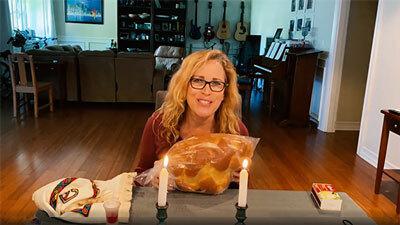
"If I'm just sitting in front of a camera praying at residents, I'm going to lose their interest," she says.

To effectively engage Jewish Home residents, Bender recalls asking herself, "What if I tried to convey the essence of Shabbat, Shabbat's spirit?"

Earlier in the year, she had successfully led the annual Seder service via video broadcast on closed circuit television from her office. "The fact that the Seder went fine, led me to see the possibilities of how to provide our services during lockdown," she says. "If we can do this, what else can we do?"

"For Shabbat evenings, I decided to show the residents something different and record the videos from my house and outside in my yard with my kids," she says. "I'm bringing the residents into my home so they feel like they are in my living room or baking challah in my kitchen. The hope is to trigger memories for them."

Before she knew it, Bender had become a director-writer-editor-producer—a big leap for someone who lacks professional video production experience. In addition, she also serves as the on-camera host, with staff, her children Holden and Shoshie, and dog Minnie as occasional featured guests.

She records her Shabbat messages via her iPhone on Wednesday afternoon, often editing them late into the evening.

Bender says she's learning as she goes, coming up with solutions as each new challenge emerges. For instance, how to get the residents to feel that they are part of the services? "No one is gathering now," Bender says. "No one receives a compliment on how they read a prayer. No one gets to hold the Torah. They see me, but I can't see them while I record."

Bender notes that while she still meets with individual residents in-person, wearing PPE and remaining at a safe distance, the communal experience had disappeared. One remedy was to create the "Spirit of Shabbat" videos, with the goal to reach everyone at the same time.

To generate a feeling of inclusiveness, Bender has opened up the process and recorded videos of individual residents saying, "Shabbat shalom." Another resident offered to sing the Jewish hymn, "Heenay Ma Tov" and Bender recorded her six feet apart in her room at JEK. She merges these videos into her Friday "Spirit of Shabbat" episodes.

In future videos, she hopes to include staff and residents more frequently to help "create community." Bender also plans to record a tour of the GV kitchen and even prepare chicken soup "with the residents."

"I'm able to include more voices and experiences now," she says. "But overall, I'm trying to encourage a feeling of closeness. I'm seeking closeness when we can't be close, we can't hold prayer services or share a hug. The residents need joy so badly right now. We are observing and celebrating Shabbat every week because I want them to smile."

Watch Rabbi Bender's "Spirit of Shabbat" episodes.

Sign up for the Los Angeles Jewish Health newsletter, Connections.

Recent Articles

Feb 12

3rd Annual LAJH Classic & Exotic Car Show

Read More
Feb 11

Major Changes in the Tax Law This Year: What It Means for You, Your Taxes, and Your Legacy

Read More
Feb 4

Los Angeles Jewish Health Pays Tribute to Martin Luther King, Jr. and Reflects on His Powerful Legacy

A shared focus on the pursuit of justice made the late Dr. Martin Luther King, Jr. and his contemporaries in the American Jewish community natural allies. This past January, Los Angeles Jewish Health honored their historic collaboration with a special Martin Luther King, Jr. Day event that brought together a diverse audience to celebrate Dr. King and help carry his legacy forward.Overseen by Rabbi Karen Bender, LAJH’s chief mission officer, the gathering featured timeless music blending Jewish songs and themes with gospel sounds rooted in the African American tradition. The program was led by Hazan Mike Stein, who served as cantor of Temple Aliyah—now HaMakom—in West Hills for more than two decades and included contributions from Cantor Jenni Asher, HaMakom’s current cantor; Broadway actress Deborah Sharpe-Taylor; singer Fumani Thomas-Schwartz; pianist David Cohen; and numerous others.“Our goal was to present a fusion of music and ideas about the melding of the two cultures, Jewish and African American,” Stein says. “We sang a song I wrote with Deborah called ‘Shalom, Shalom’; ‘Wade in the Water,’ a traditional African American spiritual that was combined with ‘Mi Chamocha’; ‘We Shall Overcome’; and ‘When the Rain Comes Down,’ which speaks to the universal struggles we all go through, no matter our faith or background. Rabbi Bender also offered a beautiful d’var Torah.”The group performs music which blends songs and themes with gospel sounds rooted in the African American tradition. Rabbi Bender’s words of wisdom helped ground the emotionally uplifting musical tribute, emphasizing how the values of Dr. King align completely with Jewish values.“Our resident community at LAJH intuits the profundity of a message that relates to the principles of justice, equality, and loving-kindness,” she said.A highlight of the event was Sharpe-Taylor’s performance as Harriet Tubman. She offered a first-person portrayal of the iconoclastic activist and brought to life her role in the Underground Railroad.“The residents loved Deborah’s reenactment. She tried to embody Harriet, talking about her life, missing her husband, and bringing people to freedom,” Asher says. “When she was finished, Rabbi Bender got up and said, ‘I almost feel as if I met Harriet Tubman today!’”During the program, Asher, the first Black female cantor to be ordained in the United States, offered insights into her own experience as a Jew of color.“It’s amazing to be visible: I have people come up to me all the time to say they’ve never seen a Black or even a female cantor,” she says. “But Jews and Judaism have moved so far in terms of diversity, and I think it’s impactful for seniors to witness this evolution for themselves. The residents of Los Angeles Jewish Health were so warm and happy to see me, which was wonderful.”Also on hand for the event were William “Mickey” Stevenson and his wife, Michelle. Mickey, a legendary producer at Motown Records and one of the principal architects of the “Motown Sound,” talked about the outstanding partnership at the label between Black artists and its executives, some of whom were Jewish.Cantor Stein says the program was particularly resonant for many of the LAJH residents in the audience.“A lot of the seniors remember the ‘60s and were politically active, some of them playing important roles in advancing civil rights in their local communities,” he says. “In fact, my wife, Kelley, an LAJH resident, was actually at the “I Have a Dream” speech march! When Rabbi Bender talked about how Black and Jewish people are connected by traditions that encompass both being slaves and being free, you could see people nodding along. It’s a powerful link that gives us all common ground to stand up for what’s right.”Cantor Jenni Asher Deborah Sharpe-Taylor as Harriet TubmanWilliam “Mickey” Stevenson 
Read More